
Frequently Asked Questions
Simple answers to frequently asked questions about animal welfare
1. What is sentience in animals?
Sentience refers to the ability of an animal or person to feel sensations, both good and bad, such as pain, pleasure, boredom, suffering and contentment. Some animals are capable of feeling more complex sensations, called emotions. Animals do not need to be able to have emotions or vocalise in order to feel negative sensations such as pain and suffering. If an animal is capable of feeling, then it is capable of experiencing a negative sensation. Sentience is by definition subjective, meaning that it differs between individuals and is dependent on their own experience. As animal welfare scientists, we attempt to measure and interpret sentience using objective means which are not influenced by individual factors.
Currently, non-human animals with a spine (vertebrates) are considered to be sentient, but some to different levels than others. For example, a chimpanzee is usually considered to have a greater range of emotions than a fish. However, this does not necessarily mean that a fish will experience less suffering than a chimpanzee, rather that they experience the same suffering in different ways, and it is more difficult to interpret what a fish is experiencing. This is one of the greatest challenges which faces animal welfare scientists and is a source of much debate amongst society at large. However, the same underlying principle remains – both chimpanzees and fish are sentient and are capable of suffering.
Currently, there is a lot of scientific support to say that some animal species without spines (invertebrates) are also sentient. These include animals such as an octopus, lobsters and crabs, and even some spiders. However, some academics are still arguing this point as measuring sentience in these species can be challenging.
2. What is the difference between animal welfare and animal rights?
In the field of animal welfare, animals are viewed as sentient beings and their quality of life is considered paramount. The animal welfare movement considers animals from a utilitarian perspective – the use of animals for human interests (e.g., for food and clothing) is understood to be necessary to an extent. The welfare of animals is evaluated on a spectrum of “very bad” to “very good”. Physical factors such as absence of pain and disease and protection from the elements are crucial for welfare; however, the way that animals perceive their life experience, and the absence of suffering, together with the ability to express natural behaviours, is equally important. The goal of animal welfare is to achieve “a good life” — the absence of negative states, together with the presence of positive states.
From the animal rights perspective, all sentient beings are equal and the use of animals by humans in any way is unacceptable. Veganism is an example of this school of thought. The animal rights movement rejects the belief of ‘speciesism’, i.e., the ideology that humans are arbitrarily designated as being superior to other species. Animal welfare is an integral part of animal rights, but the animal rights movement goes further, adopting the moral principle that animals should be able to live the natural life they choose, free from human influences or desires.
3. What is animal welfare science?
Animal welfare science is a multi-disciplinary field involving specialists from veterinary, animal behaviour (ethology), physiology and comparative psychology backgrounds. It recognises the sentience of non-human animals and aims to objectively measure and effectively improve animal welfare, commonly using methods based on physiology and behaviour, as well as husbandry and production measures.
Operational welfare indicators (OWIs) are practical tools used to measure and guide animal welfare on- and off-site. These can be physical, behavioural, environmental and nutritional, and were developed from the concept of the “Five Freedoms” for animals.
4. What are the Five Freedoms?
The Five Freedoms are widely considered to be the foundation of the field of modern animal welfare science.
- Freedom from hunger and thirst
- Freedom from discomfort
- Freedom from pain, injury and disease
- Freedom from fear and distress
- Freedom to express normal behaviour
The Five Freedoms are very well recognised and have influenced much animal welfare legislation globally. However, some consider the Five Freedoms to be an outdated concept, given how rapidly the field of animal welfare science has developed over the past 50 years.
5. What are the Five Domains of animal welfare?
As our understanding of animal sentience and welfare developed, the Five Domains model evolved from the Five Freedoms. It is a more thorough means to evaluate and measure factors which enhance animal welfare as well as compromise it. A 2016 article by animal welfare pioneer Prof. David Mellor explains that the Five Freedoms do not differentiate between the basic physiological needs of animal welfare and the affective elements of welfare — e.g. experiences of thirst, hunger, discomfort, pain, fear and distress.
Mellor’s Five Domains model advocates for “a life worth living” for animals. The goal is to provide opportunities for animals to survive and thrive: survival entails fulfilling basic needs, while thriving means animals are able to experience comfort, pleasure, interest, confidence and a sense of control — above and beyond merely mitigating negative states.
The Five Domains of nutrition, environment, health, behaviour and mental state all have positive and negative affects associated with them, as illustrated below.
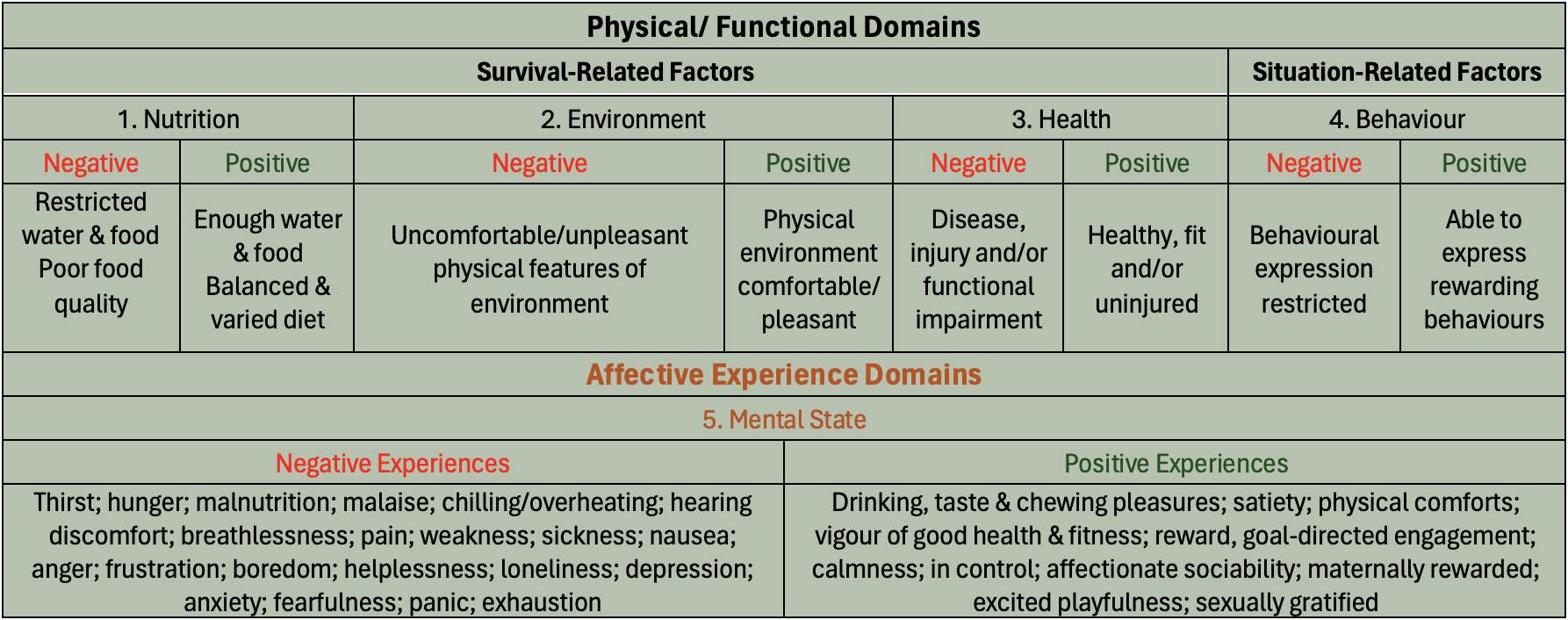
Adapted abbreviated version of the Five Domains model, taken from Updating Animal Welfare Thinking: Moving beyond the “Five Freedoms” towards “A Life Worth Living” (Mellor, 2016). “Affect” or “affective state”: feelings or emotional state as experienced by animals.
6. What does an animal welfare consultant do?
Depending on the individual’s training, background, personal strengths and interests, an animal welfare consultant may focus on a specific sector, e.g. wildlife and conservation, farmed animals, marine animals, or species such as horses, cattle, dogs or cats. The criteria by which welfare is assessed changes depending on husbandry, species and intention for animal use — welfare audits for farmed animals commonly assess housing, transport and slaughtering protocols, while criteria for animals in film production would differ.
Animal welfare consultants are frequently involved in data collection and research for animal welfare science, as well as the development and implementation of best practice standards and policies. See the Services page for a detailed list of services offered by Animal Ethos Consulting.